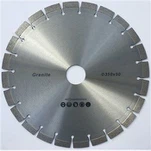
The main rock fragmentation methods of the diamond cut saw blade process are mainly fracturing and crushing and large-volume shear and avalanche, supplemented by surface grinding. For diamonds with saw tooth working surface for cutting, the exit blade surface is the extrusion zone, the front blade is the cutting zone, and the rear blade surface is the grinding zone. When cutting, the diamond particles work on the support of the carcass. In the process of cutting the stone, on the one hand, the diamond is graphitized, broken, and peeled off due to the high temperature generated by friction. On the other hand, the carcass is worn by the friction and erosion of rocks and rock dust. Therefore, the problem of the suitability of the saw blade and the rock is the problem of the wear speed between the diamond and the carcass. The characteristic of a normal working tool is that the wear of the diamond matches the wear of the matrix, so that the diamond maintains the normal edge, neither does it fall off prematurely, nor does it make the diamond smooth and slippery, and ensure that its grinding effect is fully exerted during work. More diamonds are in a state of micro-cracking and abrasion. If the strength and impact resistance of the diamond is too low, the phenomenon of "shaved head" will occur, the life of the tool will be below, and the passivation will be serious, and even the saw will not move. If excessively high-strength abrasive grains are used, the cutting edges of abrasive grains will appear flat. As a result, the sawing force is increased and the processing efficiency is reduced.
Diamond Cut Saw Blades – High-Performance Precision Cutting Solutions
Diamond cut saw blades are advanced cutting tools engineered with industrial diamond abrasives, designed to deliver fast, accurate, and durable cutting performance across a wide range of hard building materials. Unlike conventional steel or carbide blades, diamond cut blades grind through material using embedded diamond grit, providing cleaner cuts, longer life, and enhanced efficiency - especially on tough surfaces such as concrete, stone, brick, tile, and masonry.
Whether used for construction, renovation, stone fabrication, or industrial applications, diamond cut saw blades are essential tools for professionals and advanced DIY users seeking clean edges, reduced chipping, and consistent results.
What Is a Diamond Cut Saw Blade?
A diamond cut saw blade is a circular blade with segments or continuous rims containing industrial diamonds bonded to the edge. The diamond particles do the abrasive work, effectively cutting through hard substrates by grinding and micro-fracturing the surface. This method makes diamond blades ideal for materials that are too abrasive or tough for standard toothed blades.
These blades are commonly used with:
Circular saws
Cut-off saws
Angle grinders
Tile saws
Table saws
Dedicated stone cutting machines
Diamond cut blades are designed according to specific cutting needs-such as dry or wet cutting, fast cutting vs smooth finishing, and coarse vs fine bead patterns.
Core Features of Diamond Cut Saw Blades
🔹 Industrial-Grade Diamond Abrasives
High-quality synthetic diamonds are affixed to the blade rim to provide superior material penetration, high wear resistance, and long service life.
🔹 Optimized Bond Matrix
The metal bond holding the diamond grit is formulated to match the hardness of the target material - ensuring diamond exposure and blade wear occur evenly for prolonged cutting performance.
🔹 Precision-Balanced Cores
Diamond blades used at high RPM require stable cores to prevent vibration, improve cut accuracy, and protect both the blade and the cutting machine.
🔹 Cooling & Debris Evacuation Design
Blades may feature slots, segmented rims, or turbo edges that help manage heat and remove debris during cutting - essential for maintaining blade life and cut quality.
🔹 Versatile Material Compatibility
Diamond cut saw blades can be tailored for cutting an exceptional range of materials, from soft limestone and brick to hard granite and reinforced concrete.
Materials Suitable for Diamond Cut Blades
Diamond cut saw blades are used to cut:
Concrete and reinforced concrete
Brick, block, and masonry
Natural stone (granite, marble, sandstone)
Ceramic and porcelain tiles
Asphalt and road surfaces
Terrazzo and engineered stone
Hard brick and pavers
The right blade configuration ensures faster cuts, smoother surfaces, and lower tool wear even under heavy workload conditions.

Types of Diamond Cut Saw Blades
🔸 Segmented Diamond Blades
Best for fast, aggressive cutting where heat dissipation and debris removal are priorities - ideal for concrete and masonry cutting.
🔸 Turbo Diamond Blades
Provide medium-fast cutting with a smoother finish - a balanced choice for mixed materials and general construction use.
🔸 Continuous Rim Diamond Blades
Designed for smooth, chip-free edges - especially effective on ceramic tiles, porcelain, and delicate stone surfaces.
🔸 Special Bond Blades
Formulated with unique metal bonds tailored to specific material hardness and jobsite environments.
Dry Cutting vs Wet Cutting
💧 Wet Cutting
Water is applied to the blade to cool the cutting surface, reduce dust, and extend blade life. Wet cutting is recommended for precision jobs and when working with harder materials like porcelain and dense stone.
🛠️ Dry Cutting
Dry blades use advanced designs and heat-resistant materials to operate without water - suitable for outdoor construction and quick on-site cuts where water is not available.
How to Choose a Diamond Cut Saw Blade
Selecting the right diamond blade depends on several factors:
Material Hardness: Harder surfaces require finer grit and specific bond formulas.
Cut Finish: Continuous rim blades offer cleaner edges, while segmented blades cut faster.
Cutting Method: Decide between wet and dry cutting based on jobsite conditions.
Saw Compatibility: Ensure blade diameter and arbor size match your saw.
Cutting Depth & Speed: Larger blades allow deeper cuts but require more powerful saws.
Blade Specifications You May See
Diamond cut saw blades are manufactured in a range of sizes and configurations:
Diameter: Common sizes include 105mm (4″), 125mm (5″), 180mm (7″), 230mm (9″), 300mm+
Arbor Hole: Standard bore sizes like 20mm, 22.23mm, 25.4mm - machine-specific
Segment Height: Affects blade life and cutting aggressiveness
Rim Type: Segmented, turbo, continuous - tailored to cut quality vs speed
Cutting Method: Dry, wet, or dual-use
Matching these specifications ensures safer operation and optimal cutting efficiency.
Why Professionals Choose Diamond Cut Saw Blades
✔ High Cutting Speed - Diamond abrasives remove material faster.
✔ Long Tool Life - Diamond grit lasts significantly longer than conventional abrasives.
✔ Improved Precision - Less chipping and cleaner edges.
✔ Versatility - Ability to cut multiple building materials.
✔ Cost Efficiency - Fewer blade changes and better jobsite productivity.
Whether on a construction site, stone fabrication shop, or renovation project, diamond cut saw blades help professionals achieve accurate results with greater reliability and less downtime.
FAQ – Diamond Cut Saw Blades
Q: What materials are diamond cut saw blades suitable for?
A: They are suitable for cutting concrete, brick, masonry, stone, porcelain, tiles, asphalt, and engineered surfaces with higher abrasiveness.
Q: What's the difference between dry and wet diamond blades?
A: Wet blades use water to cool and reduce dust, improving blade life. Dry blades are designed with enhanced heat resistance for jobsites without water access.
Q: Why are diamond blades more expensive?
A: Diamond blades contain industrial diamond abrasives and precision bonds, which significantly improve cutting life and performance compared to conventional blades.
Q: How do I know what blade size I need?
A: Select a blade that matches your saw's diameter and arbor size, and ensure it suits the material type and cutting method you plan to use.
Packing, Storage, Handling and Transportation


After-sales service team

Technical Team

Hot Tags: diamond cut saw blade, China diamond cut saw blade manufacturers, suppliers, factory, Ceramic Diamond Saw Blade, Diamond Circular Saw, Diamond Products Blade, Diamond Rock Saw, Ceramic Specialized Saw Blade Supplier, Circular Saw Blade For Asphalt Cutting