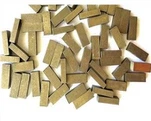
The choice of diamond grit size varies significantly depending on the material being processed, and here's how different materials affect the requirement for diamond grit size:
Soft Materials: For softer materials such as aluminum, soft ceramics, plastics, soft woods, and certain composites, larger diamond grit sizes (lower mesh number, such as 20-60 mesh) are often effective. These larger particles allow for more aggressive cutting action, necessary to quickly remove material without excessive pressure. This results in faster task completion and reduced risk of clogging.
Hard Materials: Hard materials such as hardened steel, sapphire, tungsten carbide, high-performance ceramics, and certain types of glass require smaller diamond grit sizes (higher mesh number, such as 100-300 mesh). The finer grit allows for more controlled and precise cutting, which minimizes substrate damage and ensures high-quality finishes.
Material Hardness and Abrasiveness: The hardness and abrasiveness of the material are key factors to consider when selecting diamond grit size. Harder and more abrasive materials may require finer grits for precision and to minimize tool wear, while softer materials can tolerate coarser grits for faster material removal.
Surface Finish Requirements: Understanding surface finish is critical when selecting the right grit size for grinding. Finer grits result in lower Ra and RMS values, indicating a smoother surface. The desired surface finish after grinding is often measured in Ra (Roughness Average) and RMS (Root Mean Square) values, which are inversely related to the grit size of the grinding wheel.
Cutting Speed vs. Precision: If cutting speed is more critical than the quality of the finish, coarser grit may be beneficial; if precision is paramount, a finer grit should be considered.
Material Compatibility: Finer meshes are better for softer, more delicate materials, while coarser meshes excel with harder, tougher materials.
Optimization Strategies: Some cutting tasks may benefit from multi-grit strategies or using tools that incorporate multiple grit sizes. Varying the grit along a single tool can combine aggressive material removal with a finer finish.
In summary, the selection of diamond grit size is a nuanced process that involves balancing efficiency and quality to meet specific application needs. This choice affects both the cutting speed and the surface finish, which are essential for achieving optimal performance in various industrial settings.