


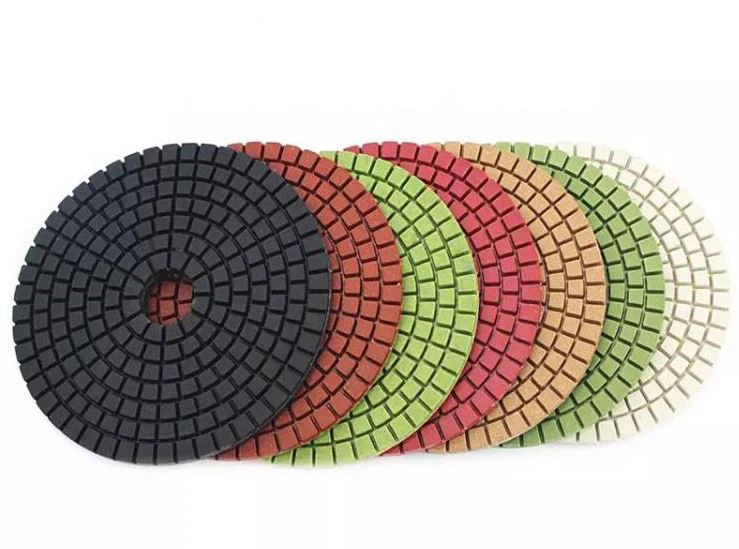
According to the different bonds, it is divided into metal bond, resin bond, ceramic bond and electroplating bond diamond abrasive tools. Resin polishing pad is a diamond grinding tool with a certain shape, which is made of resin powder as a bonding material and added with filler material through hot pressing, hardening and machining processes. Because of its good elasticity, impact resistance, good self-sharpening, and high grinding efficiency, this abrasive sheet has been popularized and applied in the machining industry. Among the various types of bonded diamond grinding tools currently produced, resin-bonded abrasives account for the largest proportion. In foreign countries, 80%-90% of cemented carbide workpieces are processed with this grinding tool, and it is gradually replacing silicon carbide grinding tools. The variety and output of domestic resin diamond polishing pads have also increased year by year, the quality has been continuously improved, and the application has become increasingly widespread. At present, the resin bonds used in diamond abrasive tools mainly include phenolic resin, polyimide resin and 11-10 black bakelite powder, etc. Phenolic resin, a white or light yellow translucent solid powder, easy to absorb moisture and agglomerate in the air, specific gravity 1.25g per cubic centimeter, soluble in alcohol and acetone. Polyimide resin is a dark yellow solid powder at room temperature. It can maintain good mechanical properties at 310-340 degrees Celsius. The density is 1.4g cubic centimeter. Strength 110Mpa is a new type of resin with good heat resistance. 11-10 Black bakelite powder is a compression molding powder made of phenolic resin as a binder, adding wood powder, mineral fillers and other additives through mixing, rolling, crushing and other processes. The hardener used in the resin bond is urotropine, the scientific name is hexamethylenetetramine, which is white crystalline powder or colorless and shiny crystal. Heating does not melt and sublimates, and at the same time partially decomposes. Its density is 1.27g per cubic centimeter, easy to absorb moisture and agglomerate, soluble in water and ethanol, the aqueous solution is alkaline. It decomposes into ammonia and formaldehyde under heating, which is irritating to the skin. It is a hardener for thermoplastic phenolic resins.


