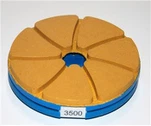
Resin polishing pad is a diamond grinding tool with a certain shape, which is made of resin powder as a bonding material and added with filler material through hot pressing, hardening and machining processes. Because of its good elasticity, impact resistance, good self-sharpening, and high grinding efficiency, this abrasive sheet has been popularized and applied in the machining industry. Among the various types of bonded diamond grinding tools currently produced, resin-bonded abrasives account for the largest proportion. In foreign countries, 80%-90% of cemented carbide workpieces are processed with this grinding tool, and it is gradually replacing silicon carbide grinding tools. The variety and output of domestic resin diamond polishing pads have also increased year by year, the quality has been continuously improved, and the application has become increasingly widespread. Resin binder mainly refers to phenolic resin, which is polymerized by phenol and formaldehyde in a certain proportion under the action of a catalyst. It is characterized by good quality, easy trimming. Widely used in semi-fine grinding, fine grinding and polishing of cemented carbide materials.
Resin Polishing Pads - Diamond Polishing Tools for Stone, Concrete & Surfaces
Resin polishing pads are professional diamond abrasive tools designed to polish, grind, and finish hard materials such as granite, marble, engineered stone, terrazzo, concrete, and natural stone. Embedded with high-quality industrial diamonds in a resilient resin bond, these pads deliver excellent elasticity, impact resistance, high efficiency, and a smooth, mirror-like finish.
These pads are widely used by stone fabricators, flooring specialists, contractors, and DIY enthusiasts to achieve professional, high-gloss finishes on countertops, floors, stairs, and decorative stone surfaces.
Features of Resin Polishing Pads
1. Premium Diamond Abrasives
Uniformly embedded diamond particles ensure fast cutting and consistent polishing.
Self-sharpening effect exposes new diamond particles, extending tool life.
Reduces the need for frequent pad replacements, saving time and cost.
2. Multi-Grit Options for Progressive Polishing
Coarse grits (50–100) for surface leveling and scratch removal
Medium grits (200–400) for refining surface texture
Fine grits (800–3000+) for high-gloss mirror finish
This progressive grit system ensures smooth transitions from rough grinding to perfect polishing.
3. Resin Bond Flexibility
Elastic and resilient for polishing flat and curved surfaces.
Heat-resistant to minimize overheating during long polishing operations.
Maintains even pressure distribution to prevent uneven polishing.
4. Wet & Dry Polishing Compatibility
Suitable for wet polishing with water cooling for dust suppression and improved gloss.
Dry polishing possible with dust extraction systems or low-speed grinders. (toolwits.com)
5. Machine Compatibility
Works with angle grinders, handheld polishers, planetary polishers, and floor polishing machines.
Available in different sizes (3″, 4″, 5″, 7″) to suit large surfaces or small edges.
Applications of Resin Polishing Pads
Granite & Marble Polishing – countertops, walls, flooring, and stairs
Concrete Surface Polishing – decorative floors, industrial surfaces, countertops
Terrazzo Finishing – achieving glossy, uniform flooring
Edge & Curved Surface Polishing – corners, stair nosing, and architectural details
Stone Restoration & Renovation – refurbishing dull or scratched surfaces
These pads are essential for stone fabrication shops, construction projects, flooring installations, and restoration works.
Advantages of Using Resin Polishing Pads
Faster polishing speed than conventional abrasives
Longer tool life with self-sharpening diamond grit
High flexibility for curved and irregular surfaces
Achieve mirror-like finish consistently
Heat and dust reduction during wet polishing
Cost-effective and versatile for multiple materials
How to Use Resin Polishing Pads Effectively
Coarse Grinding (Low Grit) – Start with coarse grits (50–100) to remove scratches and level the surface.
Intermediate Polishing (Medium Grit) – Use 200–400 grits to refine the surface and reduce micro-scratches.
Fine Polishing (High Grit) – 800–3000+ grit pads for high-gloss finishing.
Wet vs Dry – Wet polishing reduces dust and improves pad life; dry polishing is suitable for small areas or with proper dust extraction.
Pressure Control – Apply consistent but moderate pressure to avoid uneven polishing or pad damage.
Resin Polishing Pads Application

Packing, Storage, Handling and Transportation


After-sales service team

Technical Team

Hot Tags: resin polishing pads, China resin polishing pads manufacturers, suppliers, factory, Dry Diamond Polishing Pads, Dry Diamond Polishing Pads, Stone Grinding Pads, Diamond Polishing Pads For Stone, Dry Diamond Polishing Pads, Diamond Resin Polishing Pads