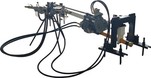
Choosing the right wire saw machine for your quarry requires a systematic evaluation of your specific needs, stone characteristics, and operational goals. Below is a step-by-step guide based on current market insights:
1. Assess Your Quarry Needs
Stone Type & Hardness: Identify whether you're cutting marble, granite, or quartzite. Hardness follows this order: marble < granite < quartzite. For quick estimation, use a knife test: if the stone scratches easily, it's softer; if not, it's harder.
Block Size & Cutting Area: Larger blocks or deeper cuts (e.g., 10m deep × 8m high) demand higher power machines.
2. Select Machine Power & Type
Power Options: Common motor powers are 37kW, 55kW, 75kW, and 110kW.
Marble: 37kW–55kW suffices for small to medium areas.
Granite: Opt for 55kW–75kW.
Quartzite: Use 75kW–110kW for optimal efficiency.
Power Source: Electric (most common for quarries), diesel (for remote areas), or hydraulic (for high torque).
Motor Pole Count: A higher pole count (e.g., 8-pole motor at 750 rpm) delivers greater torque for harder stones like granite.
3. Evaluate Machine Specifications
Cutting Depth & Wire Length: Ensure the machine supports your required depth (e.g., 37kW machines handle up to 80m wire length for 150m² cutting area).
Wire Compatibility: Check if the machine accommodates varying wire diameters and diamond grit sizes (e.g., 40/50 grit for granite, 60/70 for marble).
Speed & Precision: Look for adjustable speeds (e.g., 25–35 m/s) and features like automatic tension control for smoother cuts.
4. Prioritize Durability & Maintenance
Construction: Prefer machines built with hardened steel or heavy-duty aluminum to withstand quarry conditions.
Maintenance: Opt for models with modular designs and easily replaceable parts. Regular cleaning, lubrication, and adherence to manufacturer guidelines are critical.
5. Brand & Support
Reputation: Choose manufacturers with proven track records (e.g., TOOLWITS, BENITI) and robust after-sales support.
Testing: Request demos or trials to validate performance under your quarry's conditions.
6. Cost vs. Value
ROI Analysis: A higher upfront cost may yield long-term savings via reduced downtime, lower energy consumption, and extended wire life. For example, a German quarry achieved 350m wire life (20% above average) by pairing a 55kW machine with proper maintenance.
Quick Reference Table
| Stone Type | Recommended Power | Motor Poles (RPM) | Example Scenario |
|---|---|---|---|
| Marble | 37kW–55kW | 4–6 poles (1500–1000) | Small blocks, low hardness |
| Granite | 55kW–75kW | 6–8 poles (1000–750) | Medium depth, high hardness |
| Quartzite | 75kW–110kW | 8 poles (750) | Large blocks, extreme hardness |
By aligning machine power, durability, and support with your quarry's stone type and scale, you can maximize efficiency and ROI. Always consult manufacturers for tailored recommendations and on-site evaluations.